
How Many Hours of Light Do Strawberries Need to Produce Fruit? A Photoperiod Guide for Indoor Growers
If you have ever grown strawberries indoors only to watch the plants produce lush green leaves but zero fruit, the problem almost certainly comes down to one thing: photoperiod — the number of hours of light your plants receive each day. Unlike vegetative crops like lettuce where you simply maximize light exposure, strawberries are reproductive crops that require a carefully tuned light schedule to trigger flowering, set fruit, and develop the sugars that make them taste incredible.
In this comprehensive guide, we explain exactly how many hours of light strawberries need at every growth stage, the science behind photoperiod and flowering, and how to design a lighting schedule that delivers consistent, high-quality berry production year-round.
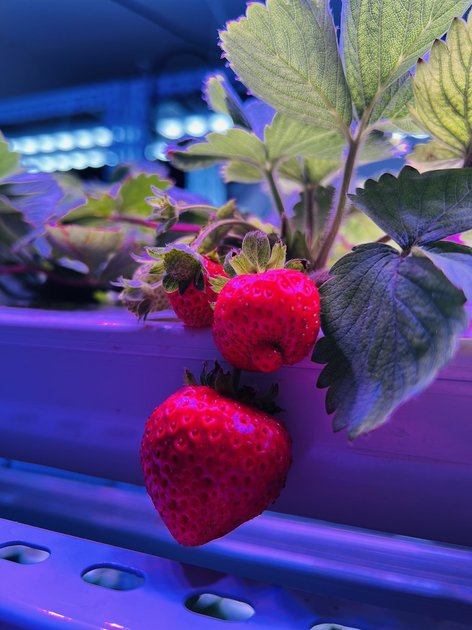
The Science of Photoperiod and Strawberry Flowering
Strawberries are classified into two main categories based on their flowering response to day length:
June-bearing (short-day) varieties such as Chandler, Camarosa, and Sweet Charlie initiate flower buds when the daily photoperiod drops below approximately 10 hours. In nature, this happens in autumn, and the plants then remain dormant through winter before flowering and fruiting in spring. When growing June-bearing strawberries indoors, you need to simulate this cycle: provide 8 to 10 hours of light per day for 6 to 8 weeks to trigger flower bud initiation, then gradually increase to 14 hours to support fruit development.
Everbearing (day-neutral) varieties such as Albion, Seascape, and San Andreas are far more popular for indoor growing because they do not require a specific photoperiod trigger. These varieties produce flowers continuously as long as temperatures stay between 15°C and 27°C and light levels remain adequate. For everbearing strawberries, the ideal indoor photoperiod is 14 to 16 hours per day, which provides enough daily light integral (DLI) for continuous fruiting without exhausting the plant.
Optimal Light Hours at Each Growth Stage
Here is a detailed photoperiod schedule for growing strawberries indoors from transplant to harvest:
Week 1–2 after transplanting (12 hours/day): Young transplants need moderate light to establish roots without excessive transpiration stress. Run your LED grow lights for 12 hours per day at PPFD of 200 to 300 μmol/m²/s. This gentle start allows the root system to develop before the plant is asked to support vigorous top growth.
Week 3–6 vegetative growth (14 hours/day): Increase the photoperiod to 14 hours and raise PPFD to 300 to 400 μmol/m²/s. During this phase, the plant builds the leaf canopy and root mass that will support fruiting. DLI target: 15 to 18 mol/m²/day. The Koray GE35-120T-F175 LED bar at 60W delivers the perfect intensity at 0.3 meters hanging height for this stage.
Week 7+ flowering and fruiting (14–16 hours/day): Once you see the first flower buds, increase the photoperiod to 14 to 16 hours and push PPFD to 400 to 600 μmol/m²/s. This is the critical period where light hours directly translate to fruit quantity and quality. DLI target: 18 to 22 mol/m²/day. At 16 hours and 500 μmol/m²/s, your DLI reaches 28.8 mol/m²/day — more than enough for maximum fruit production, though you can dial back to 14 hours (DLI 25.2) to save energy with minimal yield impact.

Why More Hours Is Not Always Better
It is tempting to think that running your grow lights 20 or even 24 hours a day would produce more and bigger strawberries. Unfortunately, plant physiology does not work that way. Here is why:
Respiration and recovery: During the dark period, plants perform essential metabolic processes including respiration (converting stored sugars into usable energy), hormone regulation (including auxin and gibberellin production that controls fruit development), and nutrient transport from roots to shoots. Without a dark period, these processes are disrupted, leading to physiological disorders.
Leaf chlorosis: Research at Cornell University found that strawberries grown under 24-hour light developed significant leaf chlorosis (yellowing) within 4 to 6 weeks. The plants were unable to properly regulate chlorophyll production without a dark rest period, leading to premature leaf death and reduced photosynthetic capacity.
Smaller fruit: Counterintuitively, excessive light hours can produce smaller berries. This is because the plant allocates energy to vegetative growth (more leaves, more runners) rather than concentrating sugars into fewer, larger fruits. A photoperiod of 14 to 16 hours strikes the ideal balance between vegetative health and reproductive output.
Designing Your Daily Light Schedule with Koray GE35
Setting up an effective light schedule for indoor strawberries is straightforward when you have the right equipment. Here is a practical setup using Koray Lighting products:
For a single shelf (1.2m × 0.4m): Install two Koray GE35-120T-F175 bars (60W each, 1200mm length) above the shelf at 0.25 meters height. Set a timer for 14 hours on, 10 hours off. At 0.25 meters, each bar delivers approximately 450 μmol/m²/s, giving you a DLI of 22.68 mol/m²/day — right in the fruiting sweet spot.
For a 4-tier vertical rack: Install one GE35-120T-F175 per tier at 0.2 meters above each shelf. Run all four bars on the same 14-hour timer. Each tier receives approximately 530 μmol/m²/s (DLI 26.7 mol/m²/day at 14 hours). Total power consumption: 240W across all four tiers — less than three traditional 100W incandescent bulbs.

Adjusting Photoperiod for Different Seasons
One of the biggest advantages of indoor strawberry growing is the ability to produce fruit year-round. However, you may want to adjust your light schedule seasonally to optimize energy costs and plant health:
Winter months (December–February): Run lights for 16 hours per day to compensate for any reduced photosynthetic efficiency due to cooler ambient temperatures. The extra light hours help maintain plant metabolism and fruit production rates.
Summer months (June–August): Reduce to 12 to 14 hours per day. Higher ambient temperatures and natural daylight (if growing in a greenhouse) mean your strawberries need less supplemental light. This also reduces heat output from your LED fixtures, lowering cooling costs.
Spring and autumn: Standard 14-hour photoperiod works perfectly. These are typically the highest-yielding periods for indoor strawberries, as ambient conditions are naturally in the optimal range.
Automating Your Light Schedule
Consistency is critical for strawberry fruiting. Even a few days of irregular photoperiod can disrupt the flowering cycle and delay harvest. We recommend using a simple digital timer or a smart controller compatible with the Koray GE35 series. The GE35 bars support 0-10V dimming, allowing you to not only automate on/off cycles but also gradually ramp up intensity at the start of each light period — simulating a natural sunrise that reduces plant stress.
The Koray Lighting GE35 series is designed for exactly this kind of precision agriculture. With 50,000-hour lifespan, IP64 waterproof rating, and consistent PPFD output over the entire service life, the GE35 ensures your strawberries receive the same quality of light on day 1,000 as on day 1. Combined with the right photoperiod schedule, you can expect continuous, high-quality strawberry production 365 days per year.

Leave A Comment