

Overview: Why Dual-Mode Rooms Change Spectrum in the Middle of a Cycle
In a controlled-environment room the light programme is not one setting. The vegetative stage and the bloom stage usually ask for different spectral composition as well as different intensity, because plants interpret the ratio of red to far red light through phytochrome, and that ratio contributes to developmental decisions such as extension growth and the timing of the transition to flowering. A widely used approach is therefore to run a broad white-based spectrum for vegetative growth and add deep red and far red during the flowering phase; a recent review of wavelength effects in agricultural plants, published in the journal Plants and available through the NIH PubMed Central archive, surveys how different wavebands act on plant secondary metabolism, which is one more reason spectrum is treated as a controllable variable rather than a fixed property of a room.
There is a second, more practical reason to study the change carefully: when the spectrum switches, the power draw usually changes as well. If the maker publishes a single efficiency number for the product, the operator cannot tell whether that number describes the mode actually being run, and running power is what ultimately determines the electricity a schedule consumes. Public tools exist for converting that consumption into an environmental figure – the US Environmental Protection Agency Greenhouse Gas Equivalencies Calculator translates electricity use into emissions equivalents – so a mode comparison is worth doing in watts as well as in photons.
The rest of this guide follows one 480 W flowering-switch board through the dimensions that matter when it is compared with another fixture: mode power, photon flux, plane PPFD at a stated hanging height, footprint, control scale and the environment the hardware is rated for.
Official Two-Mode Figures and the Conditions Behind Them
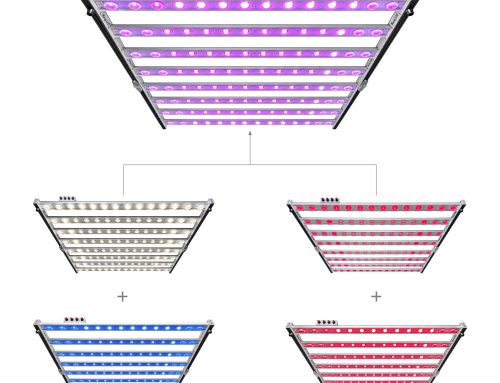
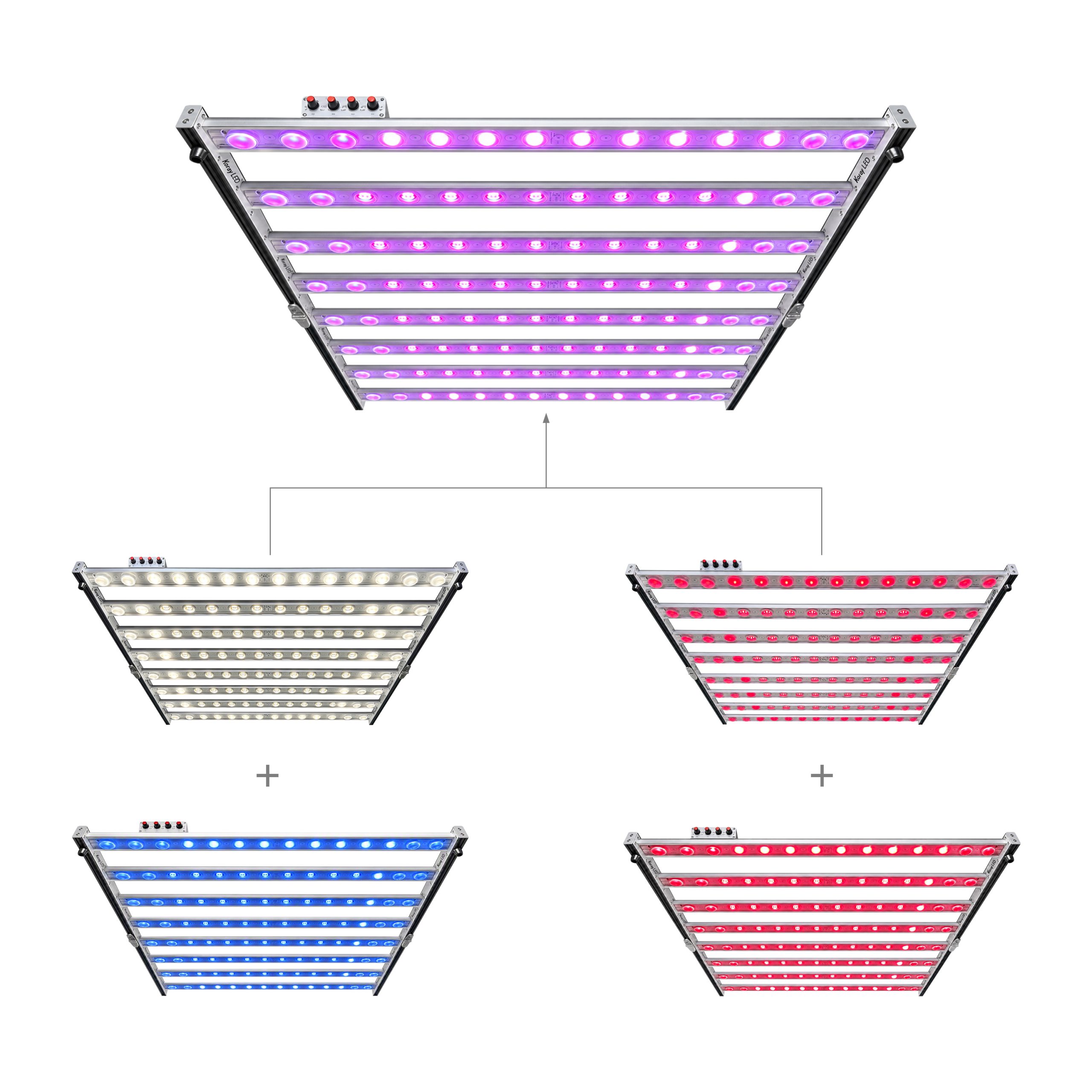
The official GS480 datasheet publishes two rows for the same fixture rather than one: the vegetable-stage row uses the F135 spectrum, and the bloom-stage row adds deep red 660 nm and far red 730 nm on top of it. The published photon flux moves from 1220 µmol/s to 1280 µmol/s when the flowering switch is engaged, and the mode power moves from 440 W to 480 W at AC230 V. The same table gives the official efficacy as about 2.7 µmol/J covering both rows, which is the manufacturer’s rounded figure; this article quotes it as published rather than recalculating it.
The plane measurements are the part most often quoted without their conditions. All three PPFD pairs were measured inside a 4 ft x 4 ft grow tent: 1200 to 1350 µmol/m²/s at 18 in (0.46 m), 950 to 1050 µmol/m²/s at 24 in (0.61 m) and 690 to 770 µmol/m²/s at 30 in (0.76 m). Because the test was made inside a reflective tent rather than an open room, those values describe a bounded, reflective environment, and the datasheet notes that the data are for reference with a tolerance of ±10 %. The full numbers are in the official GS480 series datasheet PDF, and the mode power, coverage, dimming and warranty statements are listed on the official product page.
| Dimension | Vegetable stage (F135) | Bloom stage (F135 + DRFR) | Test condition / note |
|---|---|---|---|
| Spectrum | F135 | F135 with deep red 660 nm and far red 730 nm added | Official two-row datasheet table |
| Power at AC230 V | 440 W | 480 W | Input range AC120–277 V (official product page) |
| Photon flux (PPF) | 1220 µmol/s | 1280 µmol/s | Official datasheet table |
| PPFD at 18 in (0.46 m) | 1200 µmol/m²/s | 1350 µmol/m²/s | Measured in a 4 ft x 4 ft grow tent |
| PPFD at 24 in (0.61 m) | 950 µmol/m²/s | 1050 µmol/m²/s | Same tent test protocol |
| PPFD at 30 in (0.76 m) | 690 µmol/m²/s | 770 µmol/m²/s | Same tent test protocol |
| Efficacy | about 2.7 µmol/J (official figure) | about 2.7 µmol/J (official figure) | Official table value covering both rows; not converted here |
| Coverage | 5 ft x 5 ft | 4 ft x 4 ft | Official product page and datasheet |
| Body size | 645 x 535 x 58 mm | 645 x 535 x 58 mm | Datasheet specification table |
| Colour rendering | Ra > 90 | Ra > 90 | Low-green spectrum design (datasheet) |
| Dimming chain | up to 10 units | up to 10 units | Supplied dimmer and RJ12 cable (page and datasheet) |
| Operating temperature | −30 to 40 °C | −30 to 40 °C | Datasheet specification table |
| Rated life | 50,000 h | 50,000 h | Rated at ambient temperature Ta 25 °C |
| Warranty | 3 years | 3 years | Official product page |

Mounting Height and Footprint: How the Three Planes Compare
Read side by side, the three hanging heights answer the layout question that a single number cannot.
| Hanging height | PPFD, vegetable stage | PPFD, bloom stage | Change when the switch is engaged |
|---|---|---|---|
| 18 in (0.46 m) | 1200 µmol/m²/s | 1350 µmol/m²/s | +150 µmol/m²/s |
| 24 in (0.61 m) | 950 µmol/m²/s | 1050 µmol/m²/s | +100 µmol/m²/s |
| 30 in (0.76 m) | 690 µmol/m²/s | 770 µmol/m²/s | +80 µmol/m²/s |
Two patterns follow. The first is that the bloom-stage gain is largest where the light is closest: the switch adds 150 µmol/m²/s at 18 in, 100 at 24 in and 80 µmol/m²/s at 30 in, so a room that hangs its boards high loses part of the spectral benefit as well as raw intensity. The second is that the surface area under the board matters as much as the centre reading, which is why the official coverage of 5 ft x 5 ft in the vegetable stage and 4 ft x 4 ft in the bloom stage is the more useful planning figure: the same units can be spread over a wider canopy early in the cycle and then concentrated once the plants are in bloom.
Dimension-by-Dimension Comparison Table
A dual-mode board is easy to compare badly, because one specification row can look identical to another product while the conditions behind it differ. The table below lists the dimensions that carry decision weight and what the official data states for each.
| Comparison dimension | GS480 official value | What it should be compared against |
|---|---|---|
| Mode power | 440 W (vegetable stage) / 480 W (bloom stage) at AC230 V | Whether a quoted efficiency figure applies to the mode actually being run |
| Photon flux step | 1220 → 1280 µmol/s | The size of the spectral gain, not just the name of the mode |
| Plane PPFD | 1200 → 1350 µmol/m²/s at 18 in | The hanging height and the tent size used for the test |
| Footprint | 5 ft x 5 ft (vegetable stage) / 4 ft x 4 ft (bloom stage) | The canopy that is actually planned for each phase |
| Efficacy | about 2.7 µmol/J (official) | Output per watt at the conditions stated by the maker |
| Spectral design | F135 with low-green design; Ra > 90 | Visual inspection of the crop under the lamp, not plant growth |
| Control scale | up to 10 units on one dimming chain | Room size and how many light zones must be adjusted independently |
| Body dimension | 645 x 535 x 58 mm | Ceiling clearance, rack layout and headroom |
| Environment | −30 to 40 °C operating; 50,000 h at Ta 25 °C | Room temperature control and maintenance planning |
| Compliance | CE / RoHS / FCC; 3-year warranty | Tender, import and after-sales documentation |
Scaling a Room: Serial Dimming for up to Ten Units
Single-fixture dimming becomes a problem as soon as a room holds more than a few boards. If each unit is adjusted on its own knob, neighbouring canopies drift to different intensities, and comparing two lighting treatments in the same room becomes unreliable. The GS480 addresses this with a supplied dimmer and an RJ12 telephone-style serial connection that links up to 10 units on one dimming chain, so a whole row or bench follows one setting. That is also an experimental-design convenience: a controlled trial usually needs several boards at exactly the same output, and a serial chain delivers that more repeatably than repeated manual adjustment.
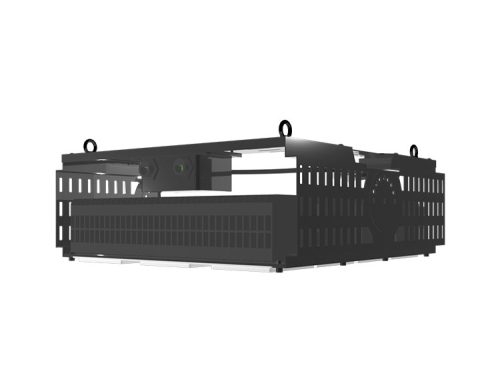
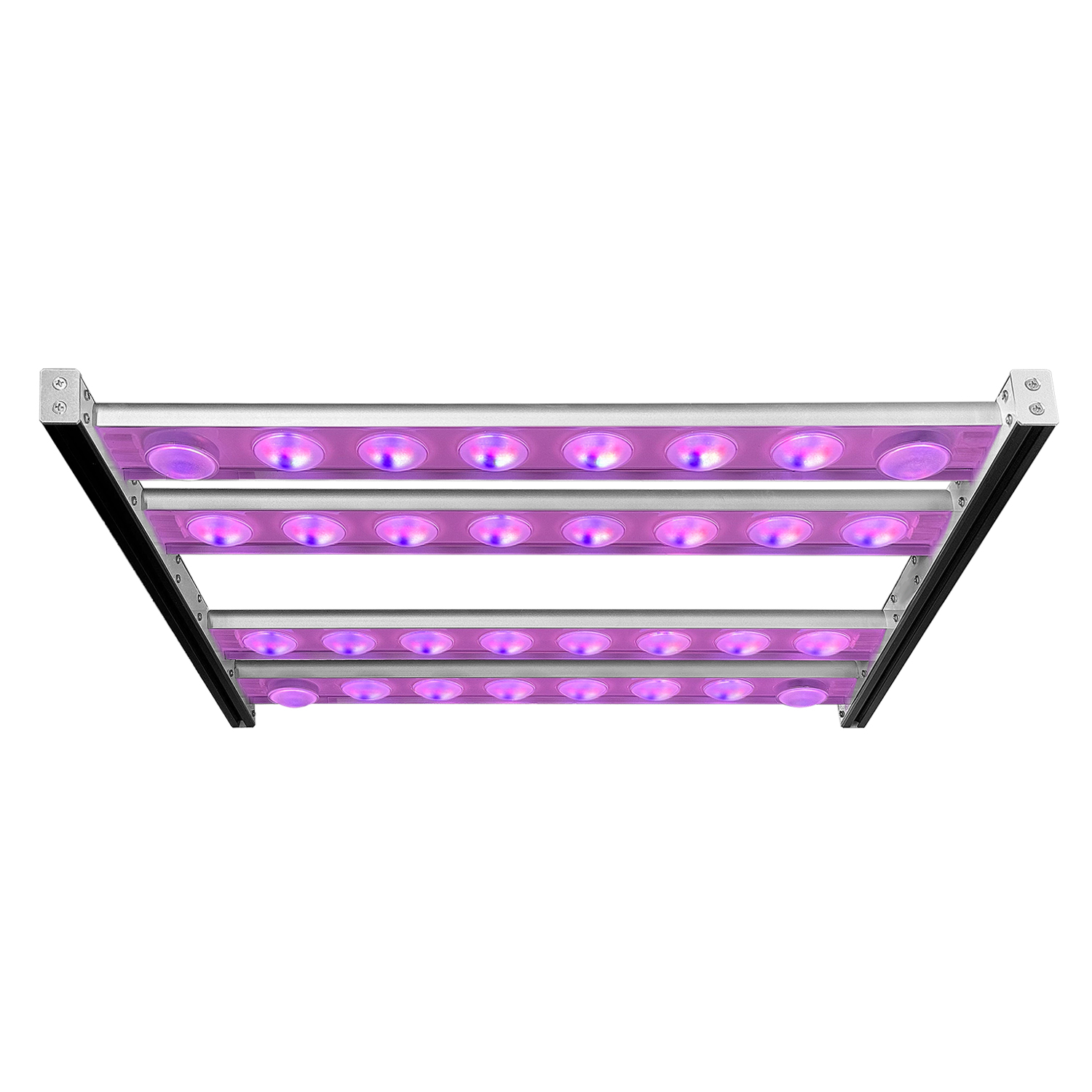
The same control architecture is where the enclosure and body dimensions start to matter. The board measures 645 x 535 x 58 mm and carries its control box on top, with the power input, a rocker switch and the red dimming knob on that box; the aluminium fin body and reflector sit below, and a central mount carries the hanging point. In a low basement or a racked bench, 58 mm of panel plus the control box is the headroom that has to be reserved per layer.
Spectral Quality, Colour Rendering and Human Observation
The F135 spectrum is described officially as a low-green design with a colour rendering index above 90. That second number deserves a note, because Ra is frequently misread as a plant metric. The National Institute of Standards and Technology describes photometry as the measurement of light as the human eye perceives it; Ra therefore says how faithfully colours appear to a person standing under the lamp, not how much photosynthesis the spectrum supports. Photosynthesis is assessed in radiometric photon terms instead, which is what PPF and PPFD express. In practice the two are complementary: a spectrum with a high colour rendering index and reduced green content lets an operator judge leaf colour, pest damage and maturity by eye under working light, which is exactly what a low-green design with Ra above 90 is meant to achieve.
The electrical side of the compliance story is equally standard. The European Commission’s Electromagnetic Compatibility Directive page explains the electromagnetic compatibility requirements that apply to electrical and electronic equipment placed on the EU market, one of the directive families covered when a product carries CE marking; the official product page also lists RoHS and FCC for the board alongside a 3-year warranty.
Selection Guidance: Where a Dual-Mode Board Fits
The official application list for the platform covers basement planting, plant tent planting, experimental planting and greenhouse planting, and the sizing logic follows directly from the two coverage figures: a bench or room sized around 4 ft x 4 ft per unit in the bloom stage can run the same hardware over a wider 5 ft x 5 ft area while the crop is vegetative. Bloom-stage crops, flowering-phase crops and medicinal plants are the plant groups the fixture is documented for, and the spectrum can be switched at the point in the cycle where the grower wants the extra deep red and far red.
Three checks are worth making before a full room is specified. Confirm which mode the quoted efficiency figure belongs to, since the official value covers both rows of a two-row table. Confirm the hanging height against the plane used in the test, because the tent-based values describe a reflective enclosure rather than an open basement. And confirm the physical fit, because a 645 x 535 x 58 mm panel plus its top-mounted control box needs vertical space in a stacked layout.
For procurement documentation, the manufacturer’s pages state 17 years of experience in plant-lighting development and manufacturing and 300+ domestic and foreign patents, listed on the patent and certification page, while the company profile page records a 2,800 square feet experimental planting area and markets including EU countries, USA, Canada, UK, Israel and Japan. The platform itself is described on the official datasheet as a shared design across the maker’s grow-light modules, which is useful context when spare units or future expansion are planned.
Set against the alternative of a fixed-spectrum board, the useful questions are narrower than the marketing usually suggests: how large a footprint one unit covers in each stage, how much photon flux the switch actually adds, and how many units a single control chain can hold. On the official figures those answers are 5 ft x 5 ft and 4 ft x 4 ft, +60 µmol/s, and up to 10 units.
Conclusion
The GS480 is a 480 W flowering-switch quantum board measuring 645 x 535 x 58 mm, and its official two-mode data make the switching behaviour measurable rather than qualitative: PPF rises from 1220 to 1280 µmol/s, plane PPFD at 18 in rises from 1200 to 1350 µmol/m²/s in a 4 ft x 4 ft tent, mode power moves from 440 W to 480 W at AC230 V, and the official efficacy figure of about 2.7 µmol/J covers both rows. Coverage of 5 ft x 5 ft in the vegetable stage and 4 ft x 4 ft in the bloom stage, together with up to 10 units on one dimming chain, defines both the per-unit plan and the way a room scales. Because the published values were measured in a reflective tent at stated hanging heights, they remain comparable only when the same conditions are applied to whatever they are compared with.

Frequently Asked Questions
How much more light does the GS480 deliver in the bloom stage?
Official figures rise from 1220 µmol/s in the vegetable stage (F135 spectrum, 440 W at AC230 V) to 1280 µmol/s in the bloom stage (F135 plus deep red and far red, 480 W at AC230 V), an increase of 60 µmol/s, while the plane PPFD at 18 in rises from 1200 to 1350 µmol/m²/s.
What footprint does one GS480 cover in each stage?
The official coverage is 5 ft x 5 ft in the vegetable stage and 4 ft x 4 ft in the bloom stage, which is why a group of units sized around a 4 ft x 4 ft bloom canopy can be spread wider while the crop is still vegetative.
How many units can be daisy-chained on one dimmer?
Up to 10 units can be linked on a single dimming chain using the supplied dimmer and an RJ12 telephone-style cable, so a row or a whole bench of boards can be adjusted as one group.
What are the rated life and operating temperature of the GS480?
50,000 hours at an ambient temperature of 25 °C, with a stated operating range of −30 to 40 °C, both published on the official datasheet.
Is the Ra above 90 figure relevant to plant growth?
No. Ra is a photometric metric that describes how colours appear to the human eye, not how much photosynthesis a spectrum can drive, which is measured in micromoles. Its practical value here is inspection: a low-green spectrum design with Ra above 90 makes it easier to assess plants visually under the lamp.




Leave A Comment