
Does the Koray GK-200W Have a Wide Beam Angle for Even Greenhouse Coverage?
Beam angle is one of the most overlooked specifications when choosing a greenhouse grow light. A fixture can have impressive PPF output on paper, but if its beam angle is too narrow, it will create harsh center hotspots and leave the edges of your growing area in shadow. The Koray GK-200W greenhouse grow light is engineered with a 120-degree beam angle and Koray’s proprietary secondary optical system to deliver smooth, uniform coverage across a wide area. In this article, we explain why beam angle matters and how the GK-200W achieves industry-leading light distribution.
What Is Beam Angle and Why Does It Matter?
Beam angle is the angular spread of light emitted by a fixture, measured in degrees. A narrow beam angle of 60 degrees concentrates light into a tight circle, producing high PPFD at the center but rapid falloff at the edges. A wide beam angle of 120 degrees or more spreads the same number of photons over a larger area, reducing peak PPFD but dramatically improving uniformity.
For greenhouse top-lighting, a wide beam angle is essential. Greenhouse crops are typically planted in rows covering a large floor area, and every plant needs access to sufficient light. A narrow-beam fixture would require more fixtures spaced closer together to avoid dark zones between coverage areas, driving up both equipment and energy costs.
The GK-200W’s 120-Degree Optical Design
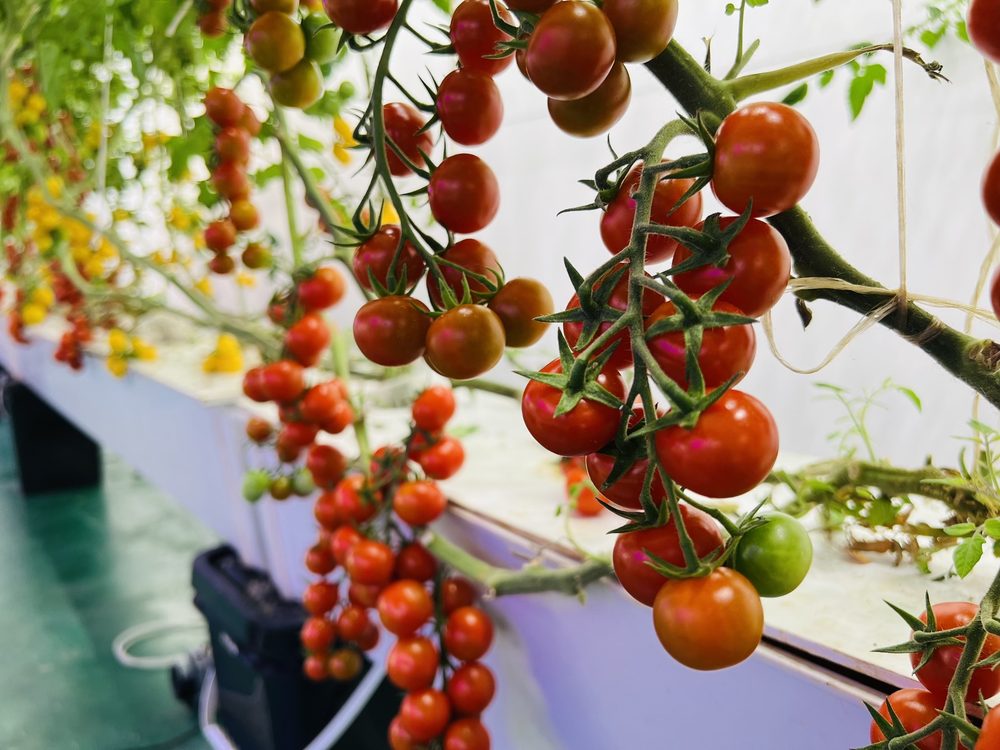
The Koray GK-200W uses a 120-degree beam angle achieved through Koray’s secondary optical lens system. Unlike bare LED chips that emit light in a Lambertian pattern (concentrated at the center with gradual falloff), the GK-200W’s lenses redirect and reshape the light output to create a flatter, more uniform PPFD profile at the canopy level.
At a typical mounting height of 1.5 meters, the 120-degree beam produces a circular coverage area approximately 3 meters in diameter where the PPFD remains above 70 percent of the center value. At 2 meters, the coverage diameter expands to approximately 4 meters. This wide, even distribution means you can space fixtures farther apart while still maintaining consistent light levels across the entire canopy.
Eliminating the Center Hotspot Problem
One of the most common complaints about LED grow lights is the center hotspot: an area of excessively high PPFD directly below the fixture that can cause photoinhibition, leaf curling, and bleaching in sensitive crops. This occurs when the fixture uses bare LEDs or simple reflectors that concentrate most of their output in a narrow cone.
The GK-200W’s secondary optical system solves this problem by redistributing photons from the center of the beam toward the edges. The result is a “top-hat” PPFD profile where the center-to-edge ratio stays below 1.5:1 across the recommended coverage area. Plants at the center receive only slightly more light than plants at the edge, promoting uniform growth across the entire bench or bed.
Coverage Area at Different Mounting Heights
The effective coverage area of the GK-200W scales with mounting height. Here are typical coverage specifications for common greenhouse crops:
At 0.5 meters, the GK-200W covers approximately 1.5 meters in diameter with a center PPFD above 800 umol/m2/s. This is suitable for low-mounted supplemental lighting in dense canopy crops.
At 1.0 meter, the coverage diameter is approximately 2.5 meters with a center PPFD around 500 umol/m2/s and an average PPFD of 380 umol/m2/s. This is the recommended height for most fruiting crops like tomatoes and peppers.
At 1.5 meters, the coverage expands to 3 meters in diameter with an average PPFD of 250 umol/m2/s. This height works well for general greenhouse supplementation.
At 2.0 meters, the coverage reaches 4 meters in diameter with an average PPFD above 160 umol/m2/s. This is suitable for high-ceiling greenhouses or low-light crops like lettuce and herbs.
Comparing Beam Angles: GK-200W vs. Narrow-Beam Alternatives
Some LED grow lights on the market use 60-degree or 90-degree beam angles, often marketed as providing “deeper penetration” or “higher intensity.” While it’s true that a narrower beam produces higher PPFD at the center, this advantage disappears rapidly as you move away from the center point. A 60-degree fixture at 1.5 meters might deliver 600 umol/m2/s at the center but only 200 umol/m2/s at a distance of 1 meter from center. The GK-200W’s 120-degree beam delivers 350 umol/m2/s at center and 250 umol/m2/s at 1 meter from center, providing far more usable coverage.
To achieve the same average PPFD over a 3-meter diameter area, a 60-degree fixture would need to be mounted lower or supplemented with additional fixtures, negating any perceived advantage of the narrower beam.
Fixture Spacing and Layout Optimization
With the GK-200W’s 120-degree beam angle, growers can optimize fixture spacing to achieve uniform coverage with minimal overlap. For a target average PPFD of 250 umol/m2/s at 1.5 meters, the recommended spacing between fixtures is approximately 2.5 to 3 meters in a square grid pattern. The slight overlap between adjacent fixtures fills in any remaining gaps and ensures that no plants fall outside the effective coverage zone.
For row crops like tomatoes or cucumbers, fixtures can be arranged in parallel rows aligned with the crop rows, with in-row spacing of 2.5 to 3 meters. This layout ensures every plant receives consistent supplemental light regardless of its position within the row.
The Role of Secondary Optics in Modern Greenhouse Lighting
Koray’s investment in secondary optical design sets the GK-200W apart from competitors who rely on bare LED boards or simple reflector cups. The precision-molded lenses are designed using ray-tracing simulation software to optimize the PPFD profile for typical greenhouse mounting heights and crop geometries. Each lens is matched to the specific LED package and positioned with sub-millimeter accuracy during assembly.
This optical engineering approach also reduces light waste. In a bare-LED fixture, a significant portion of the emitted photons strike the greenhouse structure, pathways, or floor between plant rows. The GK-200W’s optics direct photons toward the plant canopy where they can be used for photosynthesis, improving the effective efficacy of the entire lighting system.
Practical Tips for Maximizing Coverage
To get the most even coverage from your GK-200W installation, consider these guidelines. Mount fixtures at the recommended height for your crop type, typically 1.0 to 2.0 meters above the canopy. Use a staggered or offset grid layout rather than straight rows to minimize gaps between coverage circles. If your greenhouse has tall structural elements that cast shadows, position fixtures to compensate for these obstructions. Finally, use the 0-10V dimming feature to adjust light output seasonally, running at full power during short winter days and reducing output during spring and fall when natural light is abundant.
The Koray GK-200W’s 120-degree beam angle and advanced secondary optics deliver the wide, even coverage that commercial greenhouse operations demand. Combined with its high PPF efficacy, IP65 waterproof rating, and 50,000-hour lifespan, the GK-200W provides a complete lighting solution that maximizes both crop yield and energy efficiency.
Koray Lighting, founded in 2009 in Zhongshan, Guangdong, is a leading manufacturer of professional horticultural lighting with over 200 patents. The company’s products are exported to more than 60 countries and carry CE, RoHS, and FCC certifications. The GK-200W greenhouse light exemplifies Koray’s commitment to optical innovation and photosynthetic performance.


Leave A Comment