
Strawberry Grow Light Solutions: Complete Selection from Plant Factory to Greenhouse
Strawberry’s Light Requirements: A Quick Refresher
Strawberry (Fragaria × ananassa) is a facultative short-day plant, but modern day-neutral cultivars (Albion, San Andreas, Monterey) fruit continuously when given sufficient light and temperature control. The critical parameters:
- Vegetative establishment: 200–300 µmol/m²/s, 12–14 hr photoperiod, DLI 10–15 mol/m²/day
- Flowering & fruit set: 300–450 µmol/m²/s, 14–16 hr photoperiod, DLI 15–22 mol/m²/day
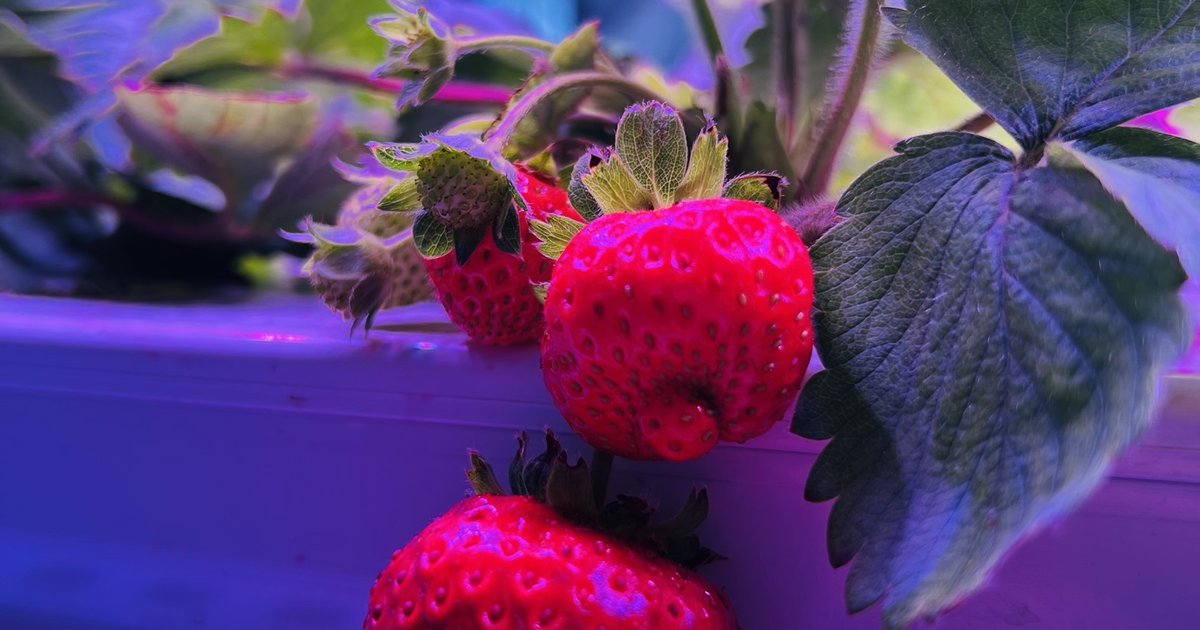
- Fruit ripening: 350–500 µmol/m²/s benefits brix accumulation and color development
- Temperature interaction: Light-driven photosynthesis peaks at 20–25 °C leaf temperature; above 30 °C, photorespiration reduces net carbon gain
Both the GE35 and GK-200W use the F175 spectrum — a balanced full-spectrum recipe with adequate blue for compact vegetative structure and strong red/far-red for flowering and fruit expansion.
Two Architectures, Two Fixtures
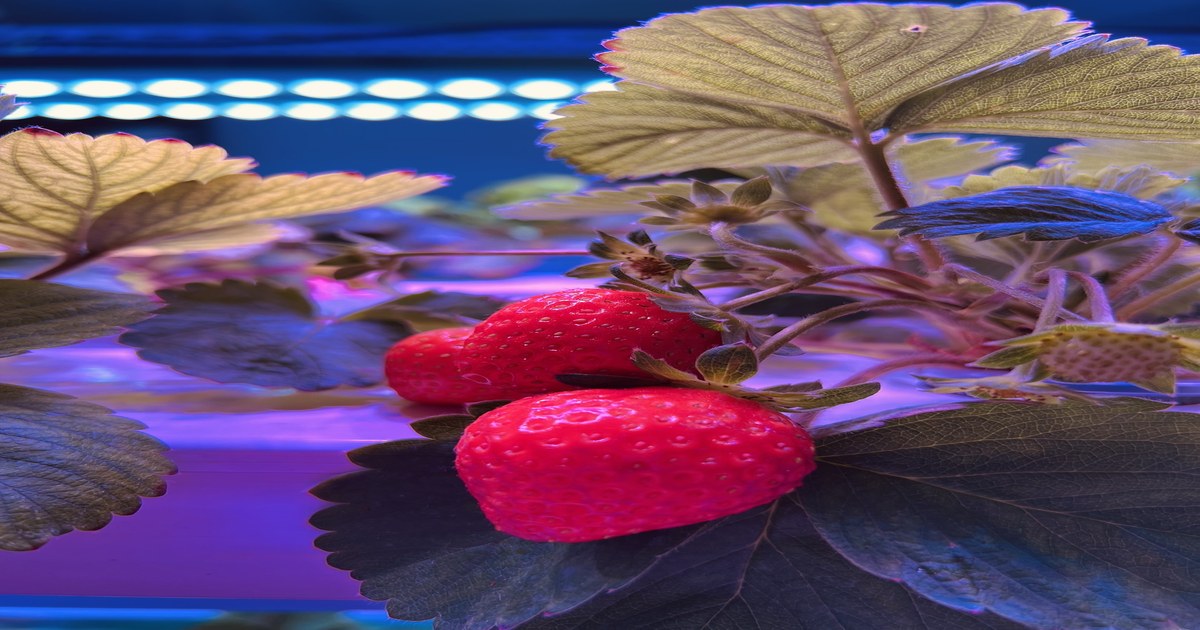
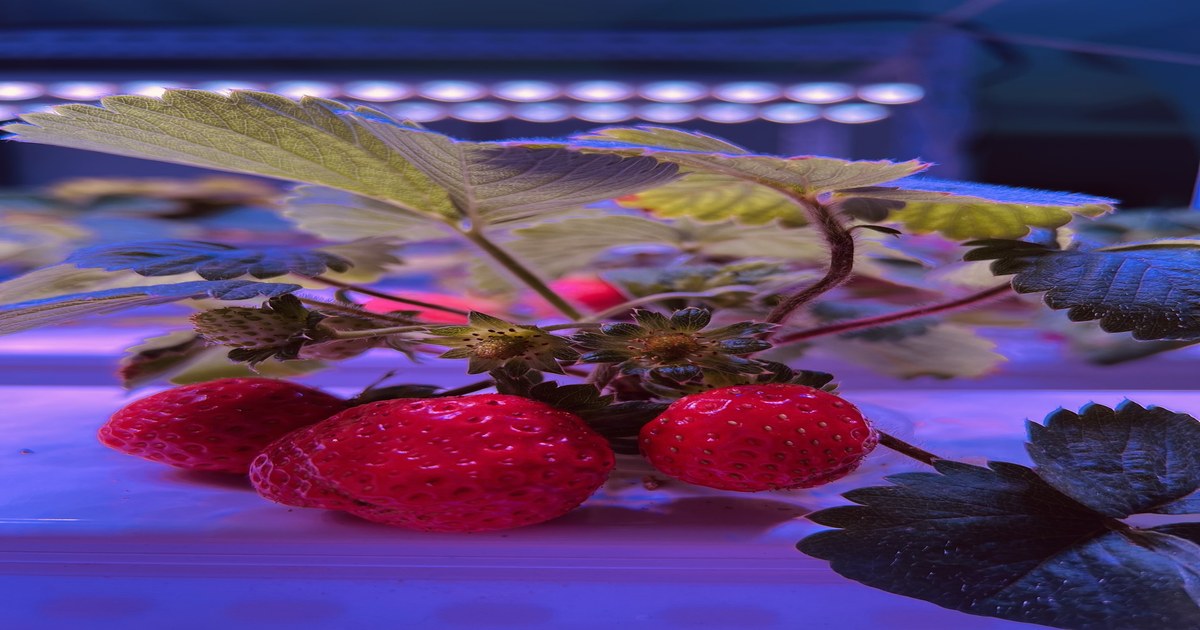
• Plant factory / indoor shelf (multi-tier, 0.2–0.3 m light-to-canopy) → GE35 linear light
• Greenhouse (single-layer, 0.5–2 m light-to-canopy, supplemental to sun) → GK-200W top light
GE35 Series: Slim Linear Light for Shelf Growing
| Model | Dimensions | Power | PPF | PPFD @0.2m | PPFD @0.3m |
|---|---|---|---|---|---|
| GE35-60 | 606 × 38 × 40 mm | 30W | 75 µmol/s | 535 µmol/m²/s | 350 µmol/m²/s |
| GE35-90 | 900 × 38 × 40 mm | 40W | 100 µmol/s | 500 µmol/m²/s | 330 µmol/m²/s |
| GE35-120 | 1200 × 38 × 40 mm | 60W | 150 µmol/s | 530 µmol/m²/s | 365 µmol/m²/s |
All GE35: F175 spectrum, AC100–277V, PF > 0.9, IP64, operating temp −30 °C to 40 °C, lifespan 50,000 hrs, CE/RoHS/FCC.
Coverage: At 0.2 m mounting height, each GE35 illuminates a strip approximately 0.2 m wide along its full length. For a 0.6 m deep shelf, mount 3 × GE35 tubes spaced 0.2 m apart for full coverage.
GK-200W: Greenhouse Top Light for Strawberry Bays
| Parameter | GK-200W-F175 |
|---|---|
| Dimensions | Ø360 × 123 mm |
| Power | 200W, AC100–277V, PF > 0.9 |
| PPF | 560 µmol/s |
| Efficacy | 2.8 µmol/J |
| PPFD @0.5m | 960 µmol/m²/s |
| PPFD @1m | 250 µmol/m²/s |
| Coverage (50% center) | 0.5m → Ø0.75m / 1m → Ø1.5m |
| IP Rating | IP65 |
| Operating Temp | −10 °C to 35 °C |
| Lifespan | 50,000 hrs |
Selection Logic: Matching Fixture to Your Setup
Plant Factory (Multi-Tier Shelves)
Shelf width determines tube length and quantity:
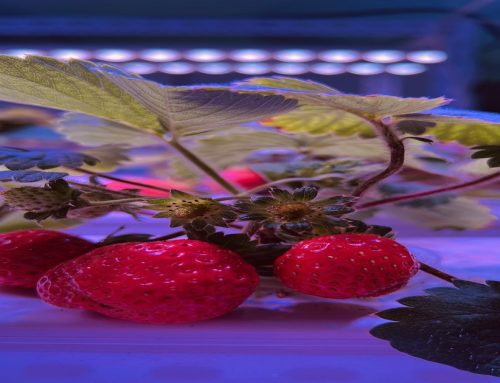
- 600 mm shelf: 3 × GE35-60 (or 2 × GE35-90 with end overhang). At 0.2 m: 500–535 µmol/m²/s — ideal for fruiting-stage strawberries.
- 900 mm shelf: 3 × GE35-90. Full-length coverage with 330–500 µmol/m²/s at 0.2–0.3 m.
- 1200 mm shelf: 3 × GE35-120. Maximum PPF per tube (150 µmol/s) for high-density production.
Shelf spacing: Allow 350–400 mm between shelves (38 mm fixture + 200–300 mm air gap + 100 mm plant height for strawberries in gutter/tray).
Greenhouse (Supplemental Top Lighting)
For strawberry table-top or gutter systems at 1–1.5 m below the light:
- Winter supplement (add 100–200 µmol/m²/s): Mount GK-200W at 1.0 m above canopy. Space 1.5 m apart in a square grid. Each fixture covers Ø1.5 m at 250 µmol/m²/s center.
- Cloudy-day boost (add 300–500 µmol/m²/s): Mount at 0.5 m. Tighter spacing (0.75 m grid) for overlapping high-intensity zones over fruiting rows.
- Year-round production greenhouse (northern climates): Combine GK-200W top light with natural sun. Target total DLI of 17–22 mol/m²/day. Run lights 14–16 hrs in winter, reduce to 4–6 hrs in shoulder seasons.
5-Year Operating Cost Comparison
| Scenario | Fixture | Qty (per 100 m²) | Annual kWh | Annual Cost @ $0.12 | 5-Year Energy |
|---|---|---|---|---|---|
| Plant factory shelf (16 hrs/day) | GE35-120 (60W) | ~50 tubes | 17,520 | $2,102 | $10,512 |
| Plant factory shelf (16 hrs/day) | GE35-60 (30W) | ~50 tubes | 8,760 | $1,051 | $5,256 |
| Greenhouse winter (12 hrs, 6 mo) | GK-200W | ~25 fixtures | 10,950 | $1,314 | $6,570 |
| Greenhouse year-round (14 hrs) | GK-200W | ~25 fixtures | 25,550 | $3,066 | $15,330 |
No lamp replacements within 5 years for any configuration (50,000 hr rated lifespan). GE35 tubes at 16 hrs/day last 8.5 years; GK-200W at 12 hrs/day lasts 11.4 years.
Installation Practicalities
GE35 in Plant Factory
- Mount to shelf underside using the integrated clip brackets or adhesive-backed cable channels.
- AC100–277V input — wire tubes in parallel to a shelf-level junction box. Use 18 AWG silicone wire for flexibility.
- IP64 protects against nutrient splash and humidity. Wipe lenses weekly in high-salt hydroponic systems.
- Recommended 0.2–0.3 m above canopy. Use adjustable shelf brackets to maintain distance as plants grow through flowering (strawberry crowns rise 5–10 cm during fruiting).
GK-200W in Greenhouse
- Suspend from gutter cables or cross-wires at target height. Two-point suspension with stainless carabiners.
- AC100–277V — daisy-chain up to 8 fixtures per 14 AWG run at 120V, or 16 at 277V.
- IP65 handles condensation drip and spray irrigation mist. No additional enclosure needed.
- Connect to greenhouse climate controller for light-sum integration: lights switch on when cumulative natural DLI falls below setpoint.
Common Mistakes in Strawberry Lighting
- Using one photoperiod for all stages. Vegetative runners benefit from 12 hrs; fruiting trusses need 14–16 hrs. Program your timer (or controller) to shift photoperiod as the crop transitions.
- Mounting GE35 too far above the shelf. At 0.5 m, PPFD drops below 200 µmol/m²/s — insufficient for fruiting strawberries. Keep it at 0.2–0.3 m.
- Ignoring heat in enclosed shelves. 3 × 60W tubes in a sealed shelf generate 180W of heat. Without airflow, leaf temperature exceeds 30 °C and photosynthesis stalls. Add a small circulation fan per shelf.
- Over-lighting in the greenhouse. If natural DLI already provides 12 mol/m²/day, adding 10 mol from LEDs pushes total DLI above the photoinhibition threshold for some cultivars. Use a light sensor and controller to cap supplemental output.
- Choosing fixture by shape preference. A round GK-200W on a 600 mm shelf wastes light over the edges. A linear GE35 in a greenhouse at 2 m height cannot deliver meaningful PPFD. Match form factor to mounting distance.
Frequently Asked Questions
Vegetative stage: 200–300 µmol/m²/s for 12–14 hrs. Flowering and fruit development: 300–500 µmol/m²/s for 14–16 hrs. The GE35 at 0.2–0.3 m delivers 330–535 µmol/m²/s for plant factory shelves. The GK-200W at 0.5–1 m provides 250–960 µmol/m²/s for greenhouse supplemental lighting.
For multi-tier plant factory shelves (600–1200 mm wide), the GE35 linear light is the correct choice — its slim 38 mm profile fits between shelves and delivers uniform PPFD at 0.2–0.3 m. The GK-200W is designed for single-layer greenhouse top-lighting at 0.5–2 m height. They serve different growing architectures.
Higher PPFD (350–500 µmol/m²/s) during fruit ripening increases photosynthate accumulation, raising brix by 1–2 degrees compared to low-light fruit. The F175 spectrum provides balanced red/blue with sufficient far-red to promote fruit expansion without excessive vegetative growth.
In a plant factory using GE35-120 (60W) at 16 hrs/day: 350 kWh/year per tube, about $42/year at $0.12/kWh. A 100-shelf facility with 2 tubes per shelf uses ~70,000 kWh/year ($8,400). In a greenhouse using GK-200W as winter supplement (12 hrs/day, 6 months): 438 kWh/year per fixture ($52.56).
Yes. Plant factories worldwide produce commercial strawberries under 100% LED lighting. Maintain 300–500 µmol/m²/s for 14–16 hours (DLI 15–25 mol/m²/day). The GE35 series at 0.2 m achieves this. Pair with CO2 supplementation (800–1200 ppm) and proper day/night temperature differential for best fruit quality.
Both are rated at 50,000 hours. At 16 hrs/day (plant factory), that is 8.5 years. At 12 hrs/day (greenhouse winter), over 11 years. No bulb changes, no ballast replacements. Budget for a PPFD verification check at year 5 to confirm output remains above 90% of initial.
About Koray Grow Lights
Koray Grow Lights develops crop-specific LED solutions for commercial horticulture. The GE35 linear series and GK-200W greenhouse light both use the F175 universal spectrum, validated across strawberry, leafy greens, and herb production. All fixtures are CE, RoHS, and FCC certified with 50,000-hour rated lifespans. For strawberry lighting plans, PPFD simulation files, and volume quotations, visit koraylights.com.
grow light solution
GE35
plant factory
© 2026 Koray Grow Lights. PPFD data from laboratory center-point measurements. Coverage values at 50% of center PPFD. Energy calculations assume stated runtime at rated wattage, 365 days/year (or 182 days for seasonal greenhouse). Actual strawberry yield and quality depend on cultivar, nutrition, CO2, temperature, and humidity in addition to lighting. This article is informational and does not guarantee specific agricultural outcomes.

Leave A Comment