
Do Strawberries Need Different Light at Seedling vs Fruiting Stage?
Strawberry plants undergo dramatic physiological changes as they move from seedling to vegetative growth to flowering and fruiting. Each stage demands different light conditions — not just in intensity, but in spectrum quality and daily duration. Understanding these shifting requirements is the key to producing strong transplants, abundant flowers, and high-quality fruit. In this guide, we explain exactly what changes at each stage and how to adjust your LED grow lighting accordingly using Koray Lighting’s proven horticultural solutions.
Why Light Requirements Change Across Growth Stages
In nature, strawberry plants respond to changing day length (photoperiod) and light quality as seasons progress. Short-day varieties initiate flower buds when days shorten, while day-neutral and everbearing varieties flower continuously but still adjust their physiology based on available light energy. Under artificial lighting, growers can mimic and optimize these natural cues by adjusting PPFD, spectrum, and photoperiod at each stage.
The three key parameters that change are: PPFD (light intensity at the canopy), DLI (cumulative daily light energy), and spectral composition (the ratio of blue, green, red, and far-red wavelengths). Getting all three right at each stage maximizes yield and fruit quality.
Seedling Stage: Low Intensity, Blue-Rich Light
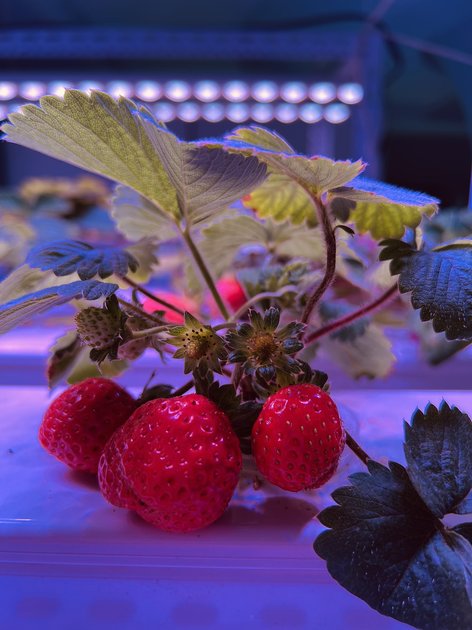
During the seedling and propagation phase, strawberry plants are delicate and vulnerable to light stress. The priorities are compact leaf growth, strong root initiation, and avoiding etiolation (stretching). Blue light (400-500nm) plays a dominant role here — it suppresses stem elongation, promotes chlorophyll synthesis, and drives photomorphogenesis.
Recommended parameters for seedlings:
PPFD: 100-200 umol/m2/s. DLI: 8-12 mol/m2/day. Photoperiod: 14-16 hours. Spectrum: Blue-enriched full spectrum or dedicated propagation spectrum.
The Koray PT8T-F4K LED tube is ideal for this stage. At 36W, it delivers 196 umol/m2/s at 0.2m distance with a spectrum optimized for tissue culture and seedling propagation. Its IP66 waterproof rating handles the high humidity of propagation domes, and the flicker-free driver ensures no stress to young plants. Hang the tube at 0.25-0.3m above seedling trays for perfect PPFD.
Vegetative Stage: Moderate Intensity, Balanced Spectrum
Once seedlings have established 3-5 true leaves, they enter the vegetative stage. The plant’s goal shifts to building leaf area, root mass, and crown diameter — the foundation that will support future fruit production. Light intensity should increase gradually to match the plant’s growing photosynthetic capacity.
Recommended parameters for vegetative growth:
PPFD: 200-400 umol/m2/s. DLI: 12-16 mol/m2/day. Photoperiod: 14-18 hours. Spectrum: Balanced full spectrum with adequate blue and red.
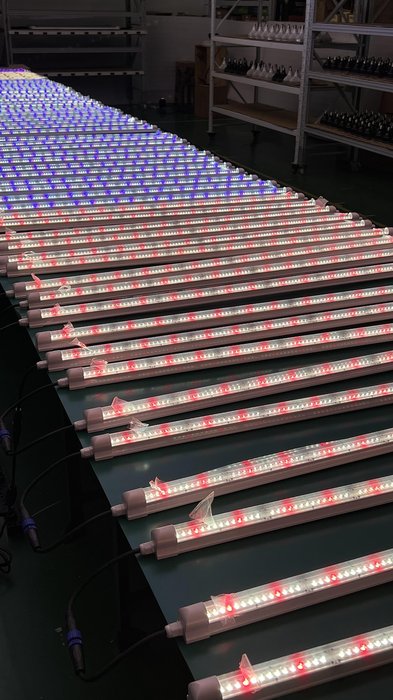
The Koray GE35-120T-F175 at 0.3m height delivers 360 umol/m2/s — right in the sweet spot for vegetative strawberry growth. Its F175 full spectrum provides balanced blue for compact growth and red for photosynthetic efficiency. The 1200mm length covers an entire standard shelf, and the IP64 rating handles increasing humidity as the canopy fills in.
During this stage, pay attention to uniformity. Uneven light causes some plants to outcompete others, leading to a non-uniform crop. Koray’s secondary optical technology ensures even PPFD distribution across the full bar length, so every plant develops at the same rate.
Flowering and Fruiting Stage: High Intensity, Red-Enriched Spectrum
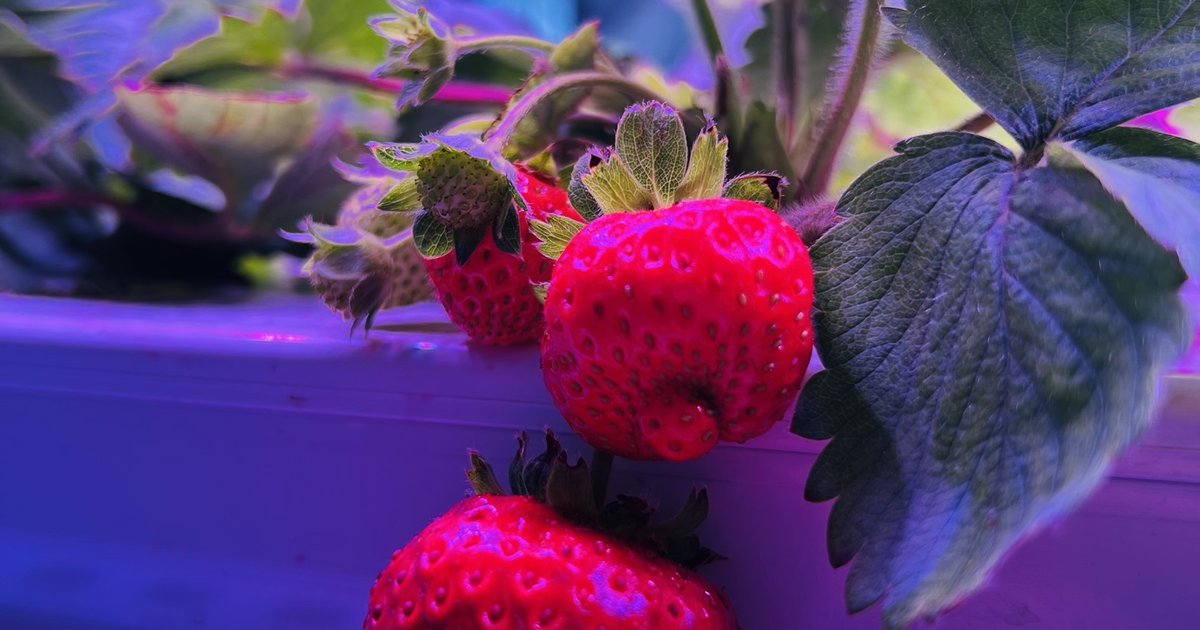
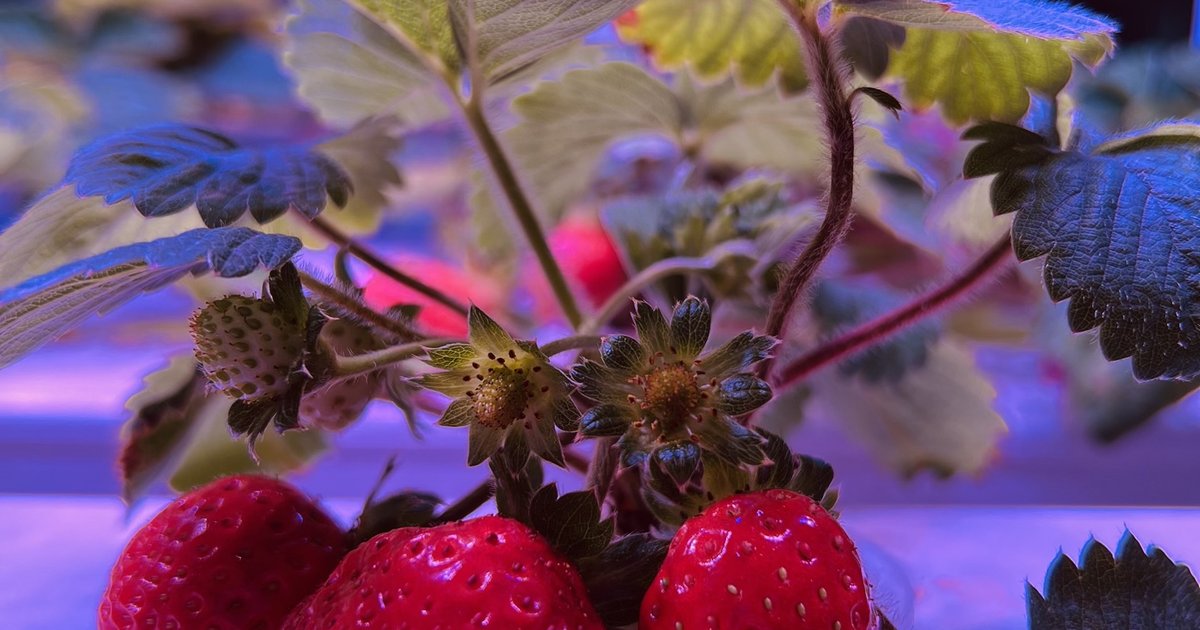
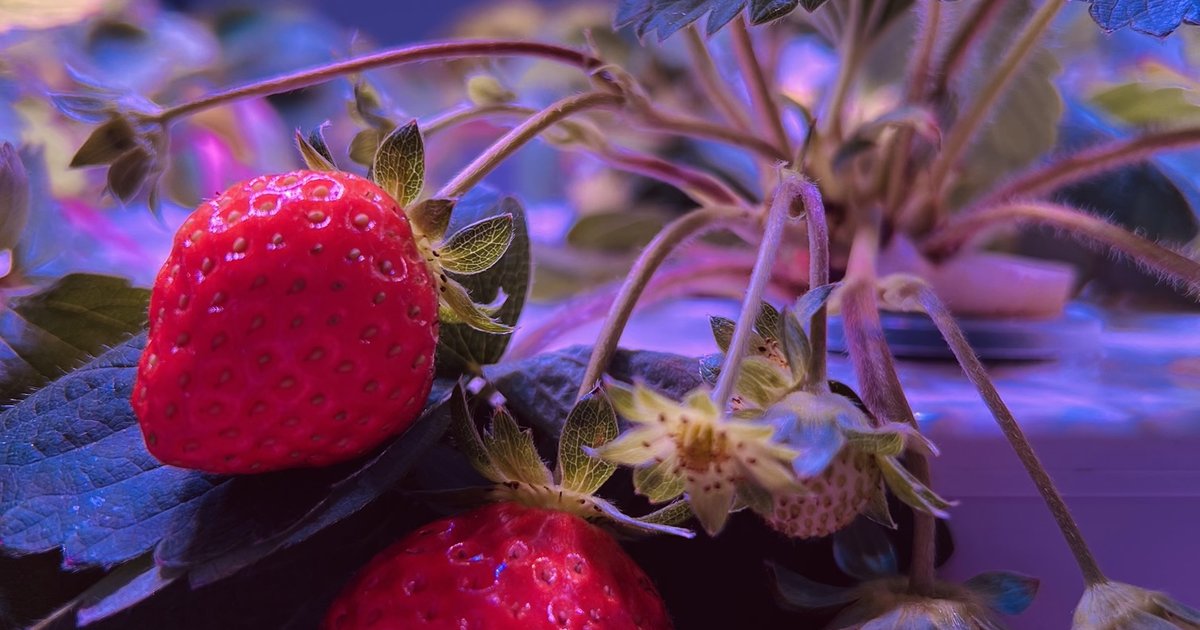
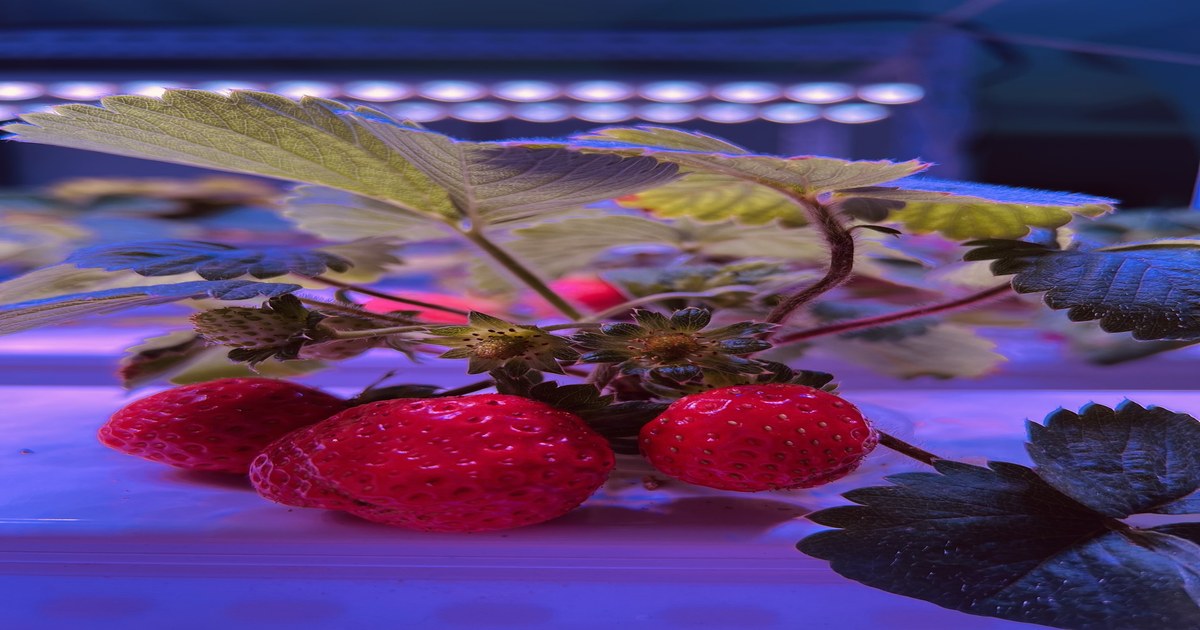
This is the most demanding phase. Strawberry plants need maximum light energy to produce flower trusses, set fruit, and accumulate sugars. Red light (620-660nm) and far-red (700-750nm) become especially important — they drive the phytochrome system that controls flowering, fruit development, and sugar metabolism. The Emerson enhancement effect means that combining red with far-red produces greater photosynthetic rates than either wavelength alone.
Recommended parameters for flowering and fruiting:
PPFD: 400-600 umol/m2/s. DLI: 16-20 mol/m2/day. Photoperiod: 12-14 hours. Spectrum: Full spectrum with enhanced red and far-red.
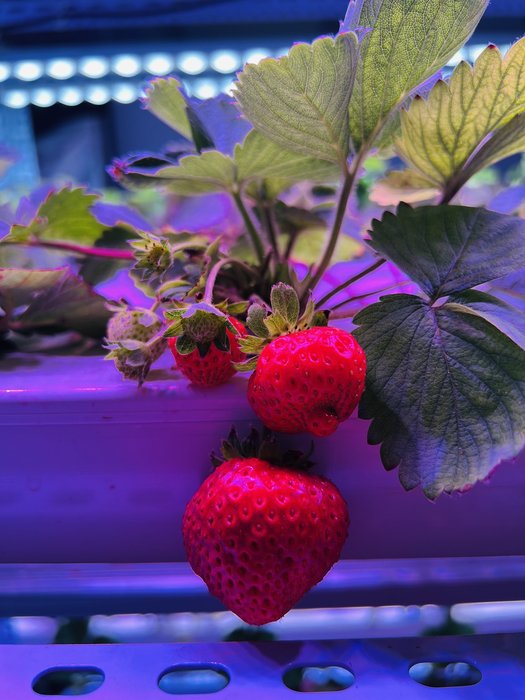
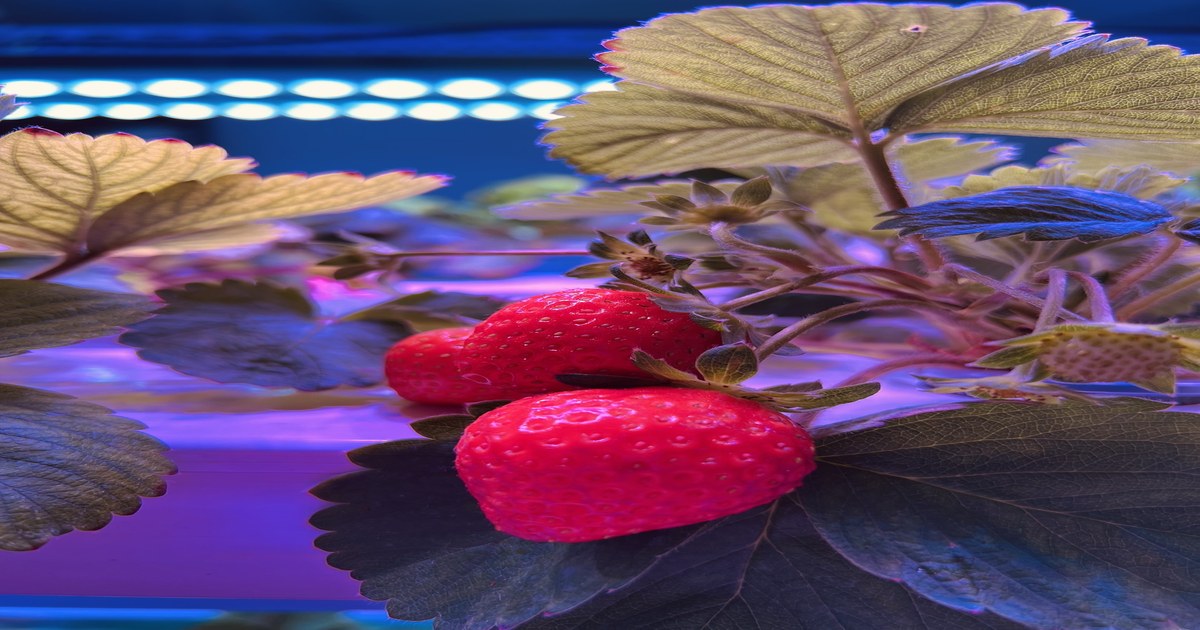
The Koray GE35-120T-F175 at 0.2m delivers 530 umol/m2/s, achieving a DLI of 22.9 over 12 hours — exceeding the minimum fruiting target. For growers who want even more red enrichment, the GE35-120T-K6 (80W, 165 umol/s) features the K6 spectrum with additional deep red, specifically designed for flowering crops, ornamentals, and succulents. It delivers 760 umol/m2/s at 0.2m — ideal for maximizing fruit set and sweetness.
Practical Lighting Transitions Between Stages
The transition between stages should be gradual. When moving seedlings to vegetative lighting, increase PPFD by 50 umol/m2/s every 2-3 days rather than jumping directly to maximum intensity. This allows the photosynthetic apparatus to acclimate and prevents photoinhibition or leaf bleaching.
Similarly, when transitioning from vegetative to flowering light, you can both increase PPFD and adjust the photoperiod. For short-day varieties, reducing photoperiod to 10-12 hours while maintaining high PPFD triggers flower initiation. For day-neutral varieties, keep photoperiod at 12-14 hours and simply increase intensity.
If you are using a single lighting system for all stages — such as the GE35 series — the simplest adjustment is hanging height. Start at 0.35-0.4m for seedlings, lower to 0.25-0.3m for vegetative growth, and drop to 0.15-0.2m for fruiting. This inverse relationship between height and PPFD means one fixture can serve the entire crop lifecycle.
Spectrum Considerations for Year-Round Strawberry Production
Commercial strawberry farms using vertical racks or plant factories often run multiple growth stages simultaneously on different shelves. In this case, using the same full-spectrum LED across all shelves — such as the GE35-120T-F175 — simplifies operations while still meeting each stage’s needs through height and photoperiod adjustments.
The F175 spectrum from Koray Lighting covers the full 400-700nm PAR range with strong output in both the blue (for vegetative vigor) and red (for flowering and fruiting) regions. Its high CRI (Ra>90) also makes it pleasant for workers to inspect plants under, unlike narrow-spectrum blurple LEDs that make everything look purple and obscure visual assessment of plant health.
Summary: Stage-by-Stage Lighting Recipe for Strawberries
Strawberries absolutely need different light conditions at each growth stage. Seedlings thrive on 100-200 PPFD with blue-rich spectrum at 14-16 hours. Vegetative plants need 200-400 PPFD with balanced full spectrum at 14-18 hours. Fruiting plants demand 400-600 PPFD with red-enhanced spectrum at 12-14 hours. Koray Lighting’s GE35 and PT8T series provide the right spectrum, adjustable intensity, and commercial-grade reliability to guide your strawberries through every stage successfully. Visit www.koraylights.com for complete product specifications and lighting plans.
Koray Lighting — 17 years of LED grow light innovation. Over 200 patents. Products trusted in 60+ countries. CE, RoHS, FCC certified. Your partner for precision strawberry production.

Leave A Comment